COES Plastic Pipes and Fittings: Applications in UAE Construction
Most plumbing problems on a UAE site don’t show up on day one. They show up in month eight, when a joint weeps behind a finished wall. Pipe material is one of the few decisions that quietly determines whether that happens, and it’s easy to get wrong when the schedule is tight and the supplier list is long.
This guide explains where COES plastic pipes and fittings fit in a typical UAE construction project, what to check before ordering, and where contractors most often go wrong.
What COES Plastic Pipes Are Used For
Plastic piping has taken over large parts of residential and commercial plumbing across the Emirates. The reasons are practical: lighter than metal, no corrosion, fewer joints to leak, and faster to install on site.
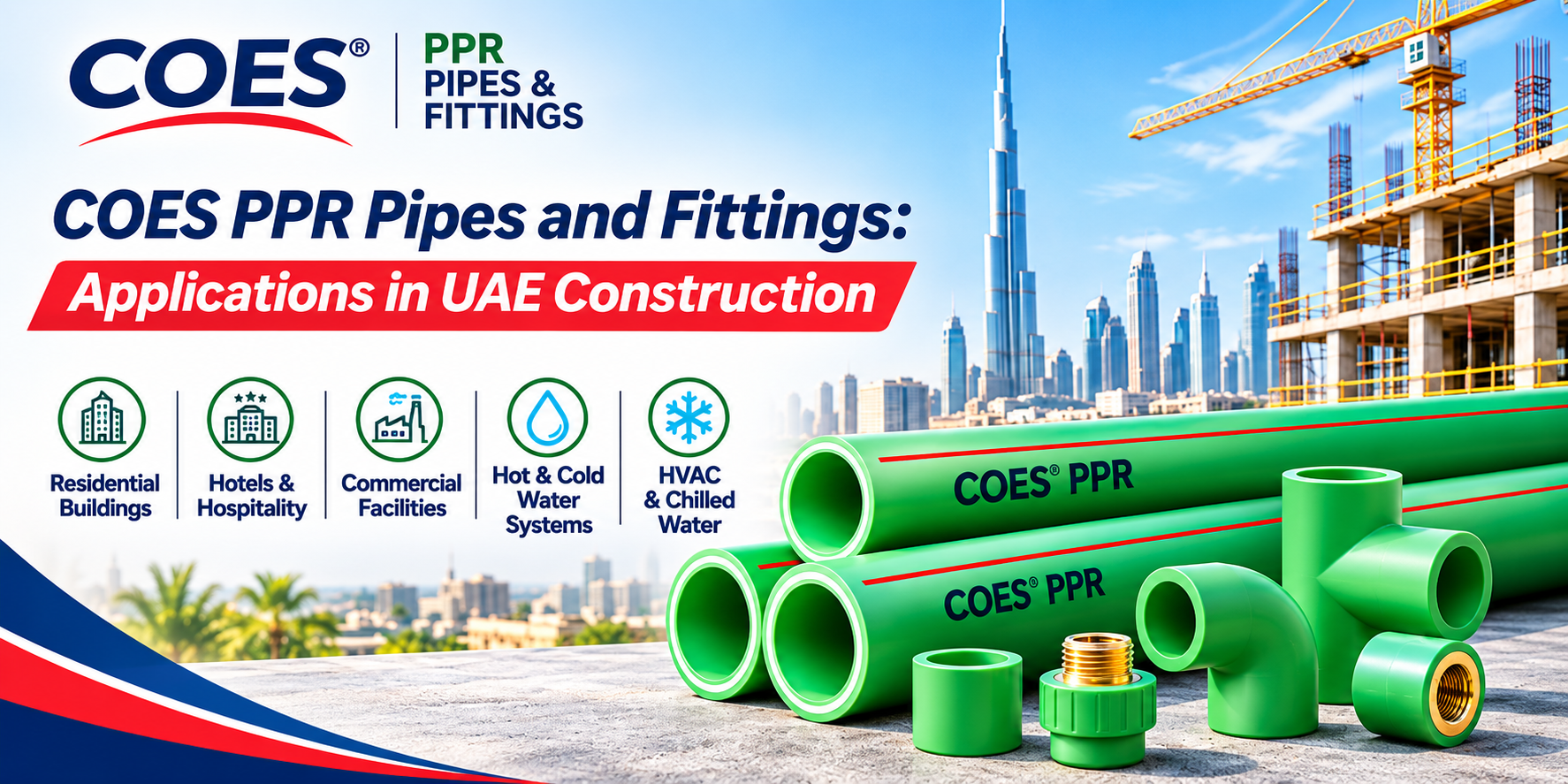
For the COES range, the main applications are:
- Hot and cold potable water distribution in villas, apartment blocks and fit-out work
- Drainage and waste lines, where chemical resistance and smooth interiors matter
- Irrigation and landscaping supply for gardens, podiums and communal areas
- Light-commercial plumbing such as kitchens, washrooms and utility rooms
Pipe type matters more than brand in most of these cases. PPR (polypropylene random copolymer) pipes, for example, are usually joined by heat fusion rather than threaded or glued, and that changes how a crew needs to work. A team used to solvent-cement jointing will need a short briefing and a few test joints before it starts on a full riser.
Why PPR Pipes Matter for Hot-Water Lines
If you’re running hot water through a building, PPR is worth a close look. Metal pipes expand and contract with temperature and can work loose at fittings. PPR is more flexible and handles repeated thermal cycling better, which is exactly what happens in a UAE building where water sits in the sun on the roof and then cools overnight.
That said, PPR isn’t a magic answer. It needs proper support spacing, expansion allowances on long runs, and fusion joints made with a clean, correctly set tool. Most of the failures I’ve seen trace back to rushed fusion, not to the material itself.
[VERIFY: confirm COES PPR pressure and temperature ratings against the current manufacturer datasheet before publishing.]
Fittings: The Part Everyone Underestimates
Pipe gets the attention. Fittings decide how the system behaves. Elbows, tees, reducers, couplings and valve adaptors are where pressure changes, direction changes and most joint stress happen.
When specifying fittings, check three things:
- Compatibility with the pipe series. Mixing fitting and pipe ranges, even within one brand, is a common source of leaks.
- Correct dimensions and pressure class for the duty.
- Availability on site. A missing 32mm tee can hold up a whole floor for a week.
A practical habit: order 10 to 15 percent more fittings than your takeoff suggests. The spares cost very little compared with a stopped crew.
Choosing a COES Supplier in Dubai and the UAE
Buyers searching for a COES supplier in Dubai or a COES distributor in the UAE usually want three things: genuine product, stock that’s actually on the shelf, and a supplier who can answer technical questions. Price comes fourth, though it’s usually the first thing people compare.
Before buying, ask the supplier for:
- The product datasheet and the relevant standard references
- Batch or traceability information where available
- A written confirmation of stock quantities and lead times
- A clear statement of the supplier’s relationship to the brand (authorised distributor, dealer or stockist). These are different things, and the difference matters for warranty claims.
The COES product range is outlined on the brand page at Alabama UAE’s COES Plastics page. Check it against your specification rather than working from memory of an older catalogue.
For wider context on how plumbing packages are procured on UAE projects, sector resources such as UAE Construction Net and UAE CSD are useful for tracking project activity and supplier requirements in the region.
Common Mistakes on UAE Sites
Ignoring heat exposure. Pipe running along a rooftop or inside a non-insulated shaft sees temperatures that catch people out. Shade, insulation and support spacing all matter more here than in temperate climates.
Mixing jointing methods. A fusion joint, a threaded metal adaptor and a glued joint can all sit on the same line. Each one needs its own care, and one weak link is enough.
Skipping the pressure test. Test before the walls close. A pressure test after tiling costs a lot more than the test itself.
Buying on price alone. A cheaper pipe that needs rework on every floor isn’t cheaper.
A Simple Specification Checklist
Before you sign off a plastic plumbing package, confirm:
- Pipe series, diameter and pressure class match the duty
- Fittings are from the same compatible range
- Support spacing and expansion allowances are on the drawings
- The installation crew has been briefed on the jointing method
- Test requirements and sign-off are written into the programme
- The supplier can confirm stock and lead time in writing
If all six are ticked, you’ve removed most of the risk that makes plumbing a headache later.
Frequently Asked Questions
Are COES plastic pipes suitable for hot water in UAE buildings?
PPR pipes are commonly specified for hot and cold water in the UAE because they handle thermal cycling well. Confirm the temperature and pressure rating for your specific series from the manufacturer’s datasheet before specifying them.
Who supplies COES pipes and fittings in Dubai?
Several suppliers and distributors stock the range. Confirm each one’s stock, their relationship to the brand, and whether they can provide datasheets and warranty documentation before ordering.
Can COES plastic pipes be used for drainage?
That depends on the product series. Drainage and potable-water products are often different ranges with different specifications, so check the datasheet for the exact application.
How do I know if a COES fitting is compatible with my pipe?
Use fittings from the same product series. Mixing ranges is a common cause of leaks, and the manufacturer’s compatibility tables are the reliable reference.